Showing posts with label Festival. Show all posts

Krishna Janmastami

Krishna Mandir In Patan Durbar Square,Nepal

  Krishna Janmashtami ,which falls on Bhadra Ashtami according to Lunar calendar or August-September according to Gregorian Calendar is an annual commemoration of the birth of the Hindu deity Krishna, the eighth avatar of Vishnu .


HISTORICAL BACKGROUND 
Lord Krishna
   

     It is believed that Lord Krishna was the incarnation of Vishnu, one of the three most important Hindu Gods. It is commonly believed that he took birth for killing Kansa, the unreligious demon king of Mathura and other demons, to establish a kingdom of peace, prosperity and religion on earth and to spread the message of brotherhood and humanity. Historians calculate that the birth of Lord Krishna goes back to the Dwapar Yug. It is in the year of Visvavasu around 3227 BC when Lord Krishna was born. He was born on a dark, stormy night on the day eight day of the second fortnight of the month of Shravana which now corresponds to the month of August-September in the Gregorian calendar. Born in the prison of Demon Kansa, from Kansa’s sister Devaki and Vasudeva, Krishna was declared to be the savior of mankind and the end of Kansa even before his birth. Krishna, right from the day of birth exhibited that he was a special child and there was extraordinary powers with him. Throughout his childhood and adolescence in Gokul, he did many things which made people believe that he was a form of God. Since then, the people of Nandgaon celebrated the birth of Krishna as a day of fortune. 

   CELEBRATION 

Krishan Mandir (Left) during Celebration at Night

    Hindus celebrate Janmashtami by fasting and staying up until midnight, the time when Krishna is believed to have been born. The temples of Lord Krishna are decorated, and bhajans and kirtans are sung or played. The Krishna Mandir in Patan Durbar Square, Narayanhiti Krishnamandir, and other temples of Lord Krishna are the centers for festivities on Krishna Janmaasthimi. Numerous devotees flock to the ancient Krishna temple in old Patan Durbar Square to keep vigil through the revered night of his birth. Observances include people sitting closely together, bodies rocking as women chant the many names of Lord Krisha, such as Narayan, Narayan and Gopal, Gopal. Some sing hymns, others clap their hands, while some others pray. Crowds of men and women edge their way slowly up narrow steps through the seated devotees to the temple's dark interior, to where the main idol stands. There they offer flowers, coins and food, and wait for a glimpse of the Krishna Janmashtami idol. After the temple priest gives them prasad, they make their way home.


Krishna Mandir of Hanuman Dhoka,Nepal

Hope the Festival Brings Peace,Prosperity and needed Stability to your LIFE !!!

 Source : Krishna Janmashtami

Tihar


    Tihar , also known as YamaPanchak or Deepawali , is a five days long hindu festival celebrated in Nepal which comes soon after Dashain  The name Tihar means the festival of lights, where many candles are lit both inside and outside the houses to make it bright at night. The five-day festival is considered to be of great importance as it shows reverence to not just the humans and the Gods, but also to the animals like crow, cow and dog, who maintain an intense relationship with the humans.

   BACKGROUND
  
   There are many myths linked with the grand Diwali or Tihar celebrations, the most popular story associated with Tihar in Nepal is the story of a King. According to the legend, the king was told by the astrologer that a snake would bite him and take away his life. As a solution the priest told him to sleep with the lamps lit around his bed and all around his palace on the day of Laxmi Puja. When the snake came to bite him, it was convinced by Goddess Laxmi and left the king unharmed. It took him to Yama Raj, the Lord of death. Yama Raj came to know about the Goddess Laxmi’s blessings on the king and and presented him a life again. It is believed that from then onwards Tihar is widely celebrated by lighting lamps and by celebrating Laxmi Puja, to welcome happiness and prosperity into ones life.


   CELEBRATION 
   The first day of the festival is called Kag Tihar ( Kag = Crow ).The crows are worshipped by offerings of sweets and dishes on the roof of the houses.Crow is believed to be the messenger of Yamaraj. Second day is Kukur Tihar ( Kukur = Dog ) .It is also called as Khincha Pooja  by the Newars. Dog, which is believed to be keeper of Lord Yamaraj, the god of death.People offer garlands, tika and delicious food to the dogs, and acknowledge the cherished relationship between humans and the dogs.This day is also observed as Narak Chaturdashi.On the morning of the third day is Gai Tihar (Gai - cow ) is observed. In Hinduism, the  cow is sign of prosperity and wealth. In ancient times people benefitted a lot from the cow like its milk, dung even its urine was used for kind of purification.Houses are cleaned and the doorways and windows are decorated with garlands made of marigolds and chrysanthemums.In the evening Goddess Laxmi, the goddess of wealth is thanked for all the benefits that were bestowed on the families by lighting oil lamps or candles on doorways and windows to welcome prosperity and well being. At night the girls enjoy dancing and visiting all the houses of the village with many musical instruments playing a historical game called Bhailo all night long.On the fourth day of Tihar, there are three different known pujas, depending on the people's specific cultural background.Most perform Goru Tihar ( Goru= Oxen) . People who follow Krishna perform Gobardhan Puja, which is worship towards Cowdung.Cowdung is seen as very useful in Nepal, as in the olden days it was used for everything from light at night to polish for the mud floors of traditional houses. The Newar community on the night of this day do Mha Pooja (Mha= Body ). Because this period is also the beginning of Nepal Samvat, or the new year of Nepalese especially commemorated by Newars, it ensures prosperity for the new year. The Nepal Samvat was initiated by Sankhadhar Sakhwa. Desui is played by boys in the late evening.The fifth and last day of Tihar is Bhai Tika , a day where sisters put Saptarangi meaning of Seven colours; Tika on foreheads of brothers, to ensure long life, and thank them for the protection they give.When the sisters give the Tika, the brothers give gifts or money in return. A special garland is made for the brothers out of a flower that wilts only after a couple of months ( Makhamali ), symbolizing the sister's prayer for her brother's long life. This festival brings close relationship between brothers and sisters.

     ENJOYMENT


  Bhailo is played in the late evening of Laxmi Pooja while Deusi on Goru Pooja . Bhailo (especially for girls)and Deusi ( for boys ) dictates the enjoyment . They collect money from all the houses by singing and dancing and share the sweets and money amongst themselves.In return the home owners give them money, fruit, rice and Selroti . FireCrackes are also used in the festival.This festival indicates the bond between animals and human and tries to strengthen the bond of family members especially brothers and sisters.
       
       As firecrackers are being banned from some years. It's better not to play with them. It may result in accident and you may get arrested. May Goddess Laxmi give peace, Prosperity and Riches to you and your family. May the bond between your family members strengthen. Stay Safe.... 


                      HAPPY DEEPAWALI             

{EAV:482ffe119332ec8f}

Gai Jatra


http://bknsresta1.blogspot.com/GaiJatra

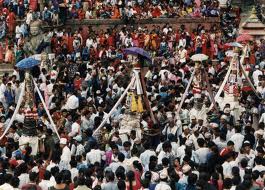
    Gaijatra, the festival of cows, (gai meaning cow and jatra meaning festival in Nepali : GaiJatra, and Newari : Saparu), is celebrated in Nepal,England, USA and Austria mainly in Kathmandu valley by the Newar community of Nepal. The festival commemorates the death of people during the year. During the festival, cows are marched in the streets and generally celebrated in the Nepalese month of August-September. The festival of cows is one of the most popular festivals of Nepal.


http://bknsresta1.blogspot.com/NewariWomenCelebratingGaiJatra
http://bknsresta1.blogspot.com/BhaktapurGaiJatra


  Gaijatra festival has its roots in the ancient ages when people feared and worshiped Yamraj , the god of death. However, the ironic sessions synonymous with the Gaijatra festival entered the tradition in the medieval period of Nepal during the reign of the Malla Kings. Hence, the present form of Gaijatra is a happy blending of antiquity and the medieval era. According to the traditions since time immemorial, every family who has lost one relative during the past year must participate in a procession through the streets of Kathmandu leading a cow. If a cow is unavailable then a young boy dressed as a cow is considered a fair substitute.In Hinduism, a cow is regarded as the most venerated among all the domestic animals. It is believed that the cow, revered as a holy animal by Hindus, will help the deceased relative's journey to heaven.According to the historical evidence, when King Pratap Malla lost his son, his wife, the queen, remained grief-stricken. The king was very sad to see the condition of his beloved queen. The king, in spite of several efforts, could not lessen the grief of his wife. He desperately wanted to see a little smile on the lips of his sweetheart, and so he announced that anyone who made the queen laugh would be rewarded adequately.During the festival of Gaijatra, the cow procession was brought before the grief-stricken queen. Then the participants began ridiculing and be-fooling the important people of the society. Finally, when the social injustices and other evils were highlighted and attacked mercilessly, the queen could not help but smile. The queen laughed and the king instituted a tradition of including jokes, satire, mockery and lampoon into the Gaijatra celebration.After the procession is over, in the afternoon, nearly everyone takes part in another age-old tradition in which the participants dress up and wear masks. The occasion is filled with songs and jokes. Mockery and humor of every kind become the order of the day until late evening. Hence, Gaijatra is a healthy festival which enables the people to accept the reality of death and to prepare themselves for life after death. According to Hinduism, "whatever a man does in his life is a preparation leading to a good life after death".

Janai Purnima


http://bknsresta1.blogspot.com/JanaiPurnima

      Janai Purnima,the Sacred Thread Festival. On this day Hindu men, especially the Brahmans and Chettris perform their annual change of Janai, a yellow cotton string worn across the chest or tied around the wrist of the right hand (male) left hand (female) This thread is given to males only during a lengthy and impressive religious ceremony called the 'Bratabandhan'. This cord initiates them into manhood and commands them to faithfuly follow the relegion. The Janai must be worn everyday of their lives from this day onwards. The 'triple cord' is a symbol of body, speech and mind, and when the knots are tied the wearer is supposed to gain complete control over each. This cord is changed if it becomes frayed or defiled, for example, when the wearer touches a woman in menstruation, during which she is considered 'unclean'. But according to Hindu rules the cord must be changed without fail by a Brahman on this day, Janai meaning sacred thread, and purni meaning Purnima or the full moon, thus pointing to the change of the thread on the auspicious full moon day.

http://bknsresta1.blogspot.com/KumbeshworTemple
http://bknsresta1.blogspot.com/KumbeshworFair


       On Purnima, there is a big fair at Kumbeshwor in Lalitpur ,Gosaikunda( a holy lake) in Rasuwa. Gosaikunda is high hilly cold region .Those people who are unable to reach in Gosaikunda goes to Kumbeshwor temple in Lalitpur  Devotees come here to worship Lord Mahadev and to tie a knot around their wrists. On the preceding day the wearer makes himself 'clean' by shaving, cutting the hair and bathing. He undergoes a partial fast, taking only one meal of foods considered to be 'clean' - no meat, onions or garlic. The next morning the family priest comes to the house. The entire family gathers around him as he reads from a holy book, performs a ceremony, which sanctifies the new thread, and places it about the recipient's neck across the chest. In payment the priest is given foodstuffs and some money.


http://bknsresta1.blogspot.com/Kwati   There are the religious significance of Janai Purnima. Water with seasame,Kush   ( sacred grass ) offered in the name of Saptarishi and the past  antecedents,because of being changed the sacred thread,this festival is very famous among the Hindu communities.In Newari communities this festival is known as' Gunhu Punhi '.Newari communities are also worn sacred yellow thread.This yellow sacred thread is sanstified or purified by the Purohit Baje,who is Newari Brahman.This yellow thread is symbol of protection from fear and diseases. They also observe the occasion of Kwati Purnima.Kwati is soup repared from nine different kinds of beans,is special delicacy, hot food, which is very good for heath