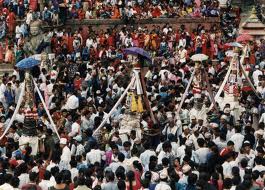
Janai Purnima,the Sacred Thread Festival. On this day Hindu men, especially the Brahmans and Chettris perform their annual change of Janai, a yellow cotton string worn across the chest or tied around the wrist of the right hand (male) left hand (female) This thread is given to males only during a lengthy and impressive religious ceremony called the 'Bratabandhan'. This cord initiates them into manhood and commands them to faithfuly follow the relegion. The Janai must be worn everyday of their lives from this day onwards. The 'triple cord' is a symbol of body, speech and mind, and when the knots are tied the wearer is supposed to gain complete control over each. This cord is changed if it becomes frayed or defiled, for example, when the wearer touches a woman in menstruation, during which she is considered 'unclean'. But according to Hindu rules the cord must be changed without fail by a Brahman on this day, Janai meaning sacred thread, and purni meaning Purnima or the full moon, thus pointing to the change of the thread on the auspicious full moon day.
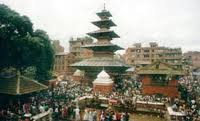
.jpg "Kumbeshwor Fair")
On Purnima, there is a big fair at Kumbeshwor in Lalitpur ,Gosaikunda( a holy lake) in Rasuwa. Gosaikunda is high hilly cold region .Those people who are unable to reach in Gosaikunda goes to Kumbeshwor temple in Lalitpur Devotees come here to worship Lord Mahadev and to tie a knot around their wrists. On the preceding day the wearer makes himself 'clean' by shaving, cutting the hair and bathing. He undergoes a partial fast, taking only one meal of foods considered to be 'clean' - no meat, onions or garlic. The next morning the family priest comes to the house. The entire family gathers around him as he reads from a holy book, performs a ceremony, which sanctifies the new thread, and places it about the recipient's neck across the chest. In payment the priest is given foodstuffs and some money.
 There are the religious significance of Janai Purnima. Water with seasame,Kush ( sacred grass ) offered in the name of Saptarishi and the past antecedents,because of being changed the sacred thread,this festival is very famous among the Hindu communities.In Newari communities this festival is known as' Gunhu Punhi '.Newari communities are also worn sacred yellow thread.This yellow sacred thread is sanstified or purified by the Purohit Baje,who is Newari Brahman.This yellow thread is symbol of protection from fear and diseases. They also observe the occasion of Kwati Purnima.Kwati is soup repared from nine different kinds of beans,is special delicacy, hot food, which is very good for heath