Robert Andrews Millikan was born on the 22nd of March, 1868, in Morrison,U.S.A , as the second son of the Reverend Silas Franklin Millikan and Mary Jane Andrews. He led a rural existence in childhood, attending the Maquoketa High School . After working for a short time as a court reporter, he entered Oberlin College in 1886. During his undergraduate course his favourite subjects were Greek and mathematics; but after his graduation in 1891 he took, for two years, a teaching post in elementary physics. It was during this period that he developed his interest in the subject in which he was later to excel. In 1893, after obtaining his mastership in physics, he was appointed Fellow in Physics at Columbia University. He afterwards received his Ph.D. (1895) for research on the polarization of light emitted by incandescent surfaces - using for this purpose molten gold and silver at the U.S. Mint.
 |
| Oil Drop Experiment |
As a scientist, Millikan made numerous momentous discoveries, chiefly in the fields of electricity, optics, and molecular physics. His earliest major success was the accurate determination of the charge carried by an electron, using the elegant "falling oil-drop method"; he also proved that this quantity was a constant for all electrons , thus demonstrating the atomic structure of electricity. Next, he verified experimentally Einstein's all-important photoelectric equation, and made the first direct photoelectric determination of Planck's constant h . In addition his studies of the Brownian movements in gases put an end to all opposition to the atomic and kinetic theories of matter. During 1920-1923, Millikan occupied himself with work concerning the hot-spark spectroscopy of the elements (which explored the region of the spectrum between the ultraviolet and X-radiation), thereby extending the ultraviolet spectrum downwards far beyond the then known limit. The discovery of his law of motion of a particle falling towards the earth after entering the earth's atmosphere, together with his other investigations on electrical phenomena, ultimately led him to his significant studies of cosmic radiation .
Millikan,in his life;remained a prolific author, making numerous contributions to scientific journals. He was not only a foremost scientist, but his religious and philosophic nature was evident from his lectures on the reconciliation of science and religion, and from his books: Science and Life; Evolution in Science and Religion; Science and the New Civilization ; Time,Matter and Values.Shortly before his death he published Electrons (+ and –), Protons; Photons, Neurtrons , Mesotrons and Cosmic Rays; his Autobiography.During World War I, Millikan was Vice-Chairman of the National Research Council, playing a major part in developing anti-submarine and meteorological devices. Advancement of Science, and was the American member of the Committee on Intellectual Cooperation of the League. He held honorary doctor's degrees of some twenty-five universities, and was a member or honorary member of many learned institutions in his country and abroad. He has been the recipient of the Comstock Prize of the National Academy of Sciences, of the Edison Medal of the American Institute of Electrical Engineers, of the Hughes Medal of the Royal Society of Great Britain, and of the Nobel Prize for Physics 1923. He was also made Commander of the Legion of Honour, and received the Chinese Order of Jade.
Millikan was an enthusiastic tennis player, and golf was also one of his recreations.Professor Millikan married Greta Erwin Blanchard in 1902; they had three sons: Clark Blanchard, Glenn Allen, and Max Franklin.He died on the 19th of December, 1953, in San Marino, California.
Gaijatra, the festival of cows, (gai meaning cow and jatra meaning festival in Nepali : GaiJatra, and Newari : Saparu), is celebrated in Nepal,England, USA and Austria mainly in Kathmandu valley by the Newar community of Nepal. The festival commemorates the death of people during the year. During the festival, cows are marched in the streets and generally celebrated in the Nepalese month of August-September. The festival of cows is one of the most popular festivals of Nepal.
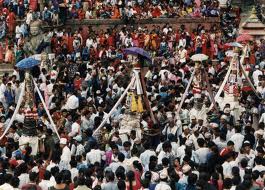
Gaijatra festival has its roots in the ancient ages when people feared and worshiped Yamraj , the god of death. However, the ironic sessions synonymous with the Gaijatra festival entered the tradition in the medieval period of Nepal during the reign of the Malla Kings. Hence, the present form of Gaijatra is a happy blending of antiquity and the medieval era. According to the traditions since time immemorial, every family who has lost one relative during the past year must participate in a procession through the streets of Kathmandu leading a cow. If a cow is unavailable then a young boy dressed as a cow is considered a fair substitute.In Hinduism, a cow is regarded as the most venerated among all the domestic animals. It is believed that the cow, revered as a holy animal by Hindus, will help the deceased relative's journey to heaven.According to the historical evidence, when King Pratap Malla lost his son, his wife, the queen, remained grief-stricken. The king was very sad to see the condition of his beloved queen. The king, in spite of several efforts, could not lessen the grief of his wife. He desperately wanted to see a little smile on the lips of his sweetheart, and so he announced that anyone who made the queen laugh would be rewarded adequately.During the festival of Gaijatra, the cow procession was brought before the grief-stricken queen. Then the participants began ridiculing and be-fooling the important people of the society. Finally, when the social injustices and other evils were highlighted and attacked mercilessly, the queen could not help but smile. The queen laughed and the king instituted a tradition of including jokes, satire, mockery and lampoon into the Gaijatra celebration.After the procession is over, in the afternoon, nearly everyone takes part in another age-old tradition in which the participants dress up and wear masks. The occasion is filled with songs and jokes. Mockery and humor of every kind become the order of the day until late evening. Hence, Gaijatra is a healthy festival which enables the people to accept the reality of death and to prepare themselves for life after death. According to Hinduism, "whatever a man does in his life is a preparation leading to a good life after death".


