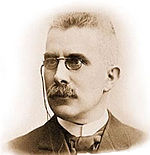
Henry Louis Le-Chatelier


http://bknsresta1.blogspot.com/HenryLouisLe-Chatelier


       Henri Louis Le Châtelier (8 October 1850 - 17 September 1936) was an influential Frenchchemist of the late 19th and early 20th centuries. He is most famous for devising Le Chatelier's principle, used by chemists to predict the effect a changing condition has on a system in chemical equilibrium.Le Chatelier was born on 8 October 1850 in Paris and was the son of French materials engineer Louis Le Chatelier and Louise Durand. His father was an influential figure who played important roles in the birth of the French aluminium industry, the introduction of the Martin- Siemens processes into the iron and steel industries, and the rise of railway transportation. As a child, Le Châtelier attended the college rollin in Paris. At the age of 19, after only one year of instruction in specialized engineering, he followed in his father's footsteps by enrolling in the Ecole polytechnique on 25 October 1869. Like all the pupils of la polytechnique, in September 1870, Le Châtelier was named second lieutenant and later took part in the Siege of Paris.After serving as an army lieutenant in the Franco-Prussian War of 1870-71,After brilliant successes in his technical schooling, he entered the Ecole des mines in Paris in 1871.Le Châtelier applied his earlier work on gas explosions to the chemical reactions occurring in blast furnaces, which are used to manufacture steel, and determined why certain gases were unexpectedly present in the furnace exhaust. By explaining blast furnace chemistry, Le Châtelier enabled industrial engineers to develop furnaces that could reach higher temperatures by preheating the combustion air with hot exhaust gases. Le Chatelier finished college at the Ècole Polytechnique, earning a degree in science and engineering in 1875. Two years later, he became a chemistry professor at the Ecole des Mines, where he began research on cement, ceramics, and glass. Some of his experiments required the measurement of very high temperatures, for which the equipment available at the time was inadequate. To measure these temperatures more accurately, Le Châtelier developed the thermocouple, an instrument consisting of a platinum wire and a platinum-rhodium alloy wire that measures temperature as a function of the difference in voltage between the two wires. He also introduced the use of known boiling and melting points as standards for calibrating thermocouples. Around the same time, Le Châtelier developed an optical pyrometer, another temperature measurement device. Although other methods have replaced the pyrometer, Le Châtelier's equipment was useful at the time, and scientists continue to employ thermocouples in high-temperature research.
Le Châtelier's scientific experience culminated in the discovery for which he is best known today- Le Châtelier's principle. Announced in 1884, the principal states that when a system is in equilibrium and one of the factors affecting it is changed, the system will respond by minimizing the effect of the change. Essentially, the principle predicts the direction that a chemical reaction will take when pressure, temperature, or any other condition is altered. By employing Le Châtelier's principle, scientists were able to maximize the efficiency of chemical processes. For example, Fritz Haber (1868-1934) utilized the principle to develop a practical process for synthesizing ammonia from nitrogen and hydrogen. Le Châtelier himself had tried this but was unsuccessful.Le Châtelier married Geneviève Nicolas, a friend of the family and sister of four fellow students of la polytechnique. They had seven children, four girls and three boys, five of whom entered scientific fields; two were lost preceding Le Châtelier's death.
For the rest of his career, Le Châtelier continued teaching. In addition to his position at the Ecole des Mines, he held posts at the College de France and at the Sorbonne. After working for the French government during World War I, Le Châtelier retired from the Ecole des Mines in 1919 at age 69.He died on 17 September 1936.

Le Châtelier's Principle states that a system always acts to oppose changes in chemical equilibrium; to restore equilibrium, the system will favor a chemical pathway to reduce or eliminate the disturbance so as to restabilize at thermodynamic equilibrium.If a chemical system at equilibrium experiences a change in concentration, temperature or total pressure, the equilibrium will shift in order to minimize that change.This qualitative law enables one to envision the displacement of equilibrium of a chemical reaction.
For example:
A change in concentration of a reaction in equilibrium for the following equation:
N2(g) + 3H2(g) ⇌ 2NH3(g)
1vol         3vol            2vol
        4 vol                   2 vol
                                   ◘ Decrease in volume takes place  
If one increases the pressure of the reactants (Nitrogen, N2 and Hydrogen, H2) the reaction will tend to move towards the products to decrease the pressure of the reaction.
Another example: In the Contace Process for the production of sulphuric acid, the second stage is a reversible reaction,the oxidation of SO:
2SO2(g) + O2(g) ⇌ 2SO3(g)
2vol              1vol           2vol
        3vol                        2vol
                                       ◘ Decrease in volume takes place
  
The forward reaction is exothermic and the reverse reaction is endothermic. If the temperature were increased, the larger amount of thermal energy in the system would favor the endothermic reverse reaction, as this would absorb the increased energy; in other words the equilibrium would shift to the reactants in order to remove the stress of added heat. For similar reasons, lower temperatures would favor the exothermic forward reaction, and produce more products.


Bisket Jatra

http://bknsresta1.blogspot.com/BisketJatra


The Nepalese follow their own calendar system known as the Bikram Era or Bikram Sambat, which is accredited to King Bikramaditya. He started the solar calender some two thousand years ago. This festival is celebrated in the last week of the year and lasts till the second week of the of the first month of the New Year.So it is generally celebrated as the NEW YEAR in Bhaktapur.On this day, devotees take a dip in the holy Bagmati River at Pashupatinath temple. Pilgrims also visit other religious spots. In Bhaktapur, which is 15 Kilometers east of Kathmandu, the New Year celebrations takes place with an added importance as the " Bisket Jatra or Festival of Bisket". During Bisket Jatra a tall wooden ceremonial poll called 'yosin' is erected in one of the main squares. This festival commemorates the great battle of Mahabharata and the wooden pole symbolizes victory. After two days, images of the god Bhairab and his female counterpart Bhadrakali are enshrined in two large greatly decorated chariots and pulled through crowds of cheering on-lookers. When the chariot reaches the city center, a tug-of-war between the inhabitants of the two neighborhoods takes place. The winners of a tug-of-war are considered blessed with good fortune for the coming year. This festival goes on for nine days. New Year is celebrated with added aroma in Sankhu, some 20 km east of Kathmandu. Both Hindus and Buddhist worship the Bajra Jogini godess. During New Year, the deity's image is put on palanquin and carried around the town with a huge colorful procession.


   While at the same time in Bhaktapur at Thimi the festival is celebrated in different form. ‘Sindoor Jatra’ (Vermilion Powder Festival) .In Thimi, the local crowd celebrate it by carrying the palanquins of Hindu deities across the town square. People smear and throw vermilion , as they carry the palanquin of the deities. Yomaris(Newari rice cake prepared especially during New Year) are thrown from homes towards the Balkumari temple, while the boisterous crowd tries to catch it.According to a local belief, a son will be born to anyone who catches a yomariA day before a new year, firing of forest wood takes place which is known as Gunsin Chhoyekegu”.“A traditional wooden pole with flags used to be erected in front of Balkumari Temple of Thimi but this is no more in practice now. On this day chariot festival takes palace in Vishnuvir. During that same night, chariots of deities are carried with Dhimay Baja (Indigenious Music) & flaming torches to Kwachhen (Dakshin Barahi) from Layaku and the Chariots are revolved there. On the New Year day (1st Baisakh), devotees from around the town gather at Balkumari,one of Bhairab’s consorts and worship all throughout the day. In the evening hundreds of ceremonial oil lamps are lit. Some devotees light oil lamps even on their legs, chests, foreheads, arms & lie in motionless positions for hours. The second of Baishakh and the third day of the Bisket Jatra is an important day when surrounding villages bring Khats(Chariot) with images of different gods to Balkumari early in the morning. Thirty two chariots of deities are gathered and revolved round Balkumari temple by the festival participants. People carry flaming torches or play drums/cymbals. Vermilion powder is spread around each others body with joy. In no time the whole locality turns into colourful orange. The environment becomes unbelievably too festive by the time. The festival reaches its climax when the Khat of Ganesh from Nagadesh arrives. While people try to return the Khat, all other Khats try to block its way. By hook or by crook they finally succeed to return. The festival gets prolonged until they succeed. Afterwards the procession moves toward Taleju Temple. Numbers of animal sacrifices are made here. The event and the surrounding are crowded by the devotees again.On the same day, in a small village of Bode another Khat festival take place-here seven Khats are revolved around. Following this event – an exciting tongue piercing festival takes place at Bhangu Tole of Bode. A volunteer from the Shrestha family gets his tongue pierced in a spiritual trance with an iron spike and walks around the town shouldering a round bamboo rack with flaming torches. It is believed that the successful completion of this painful rite bring good fortune to the villagers & the volunteer himself. On the forth day of Bisket Jatra Chariots of Chapancho and Chhoday are also brought and taken


Sindoor Jatra @ Madhyapur Thimi– Nepali New Year 2069 BS


Events
When  (AD)
Where
Time
Bishnu Bir Jatra

Siddhi Ganesh Jatra
12th April
Madhyapur Thimi,
Ward No. 14
Nagades
4.00 PM

11.00 PM
Bal Kumari Jatra

Dakshin Barahi Jatra

Bishnu Bir Jatra
13th April
Bal Kumari

Bal Kumari

Bal Kumari

2.00 PM

Afternoon

Evening
32 Chariot festival

Tongue Penetration Festival

Siddhi Ganesh Jatra
14th April


Morning
Bal Kumari


Bode

Nagades
7.00 AM

12 Noon

7.00 AM
TONGUE PENETRATION IN BODE

Balkumari
BALKUMARI